

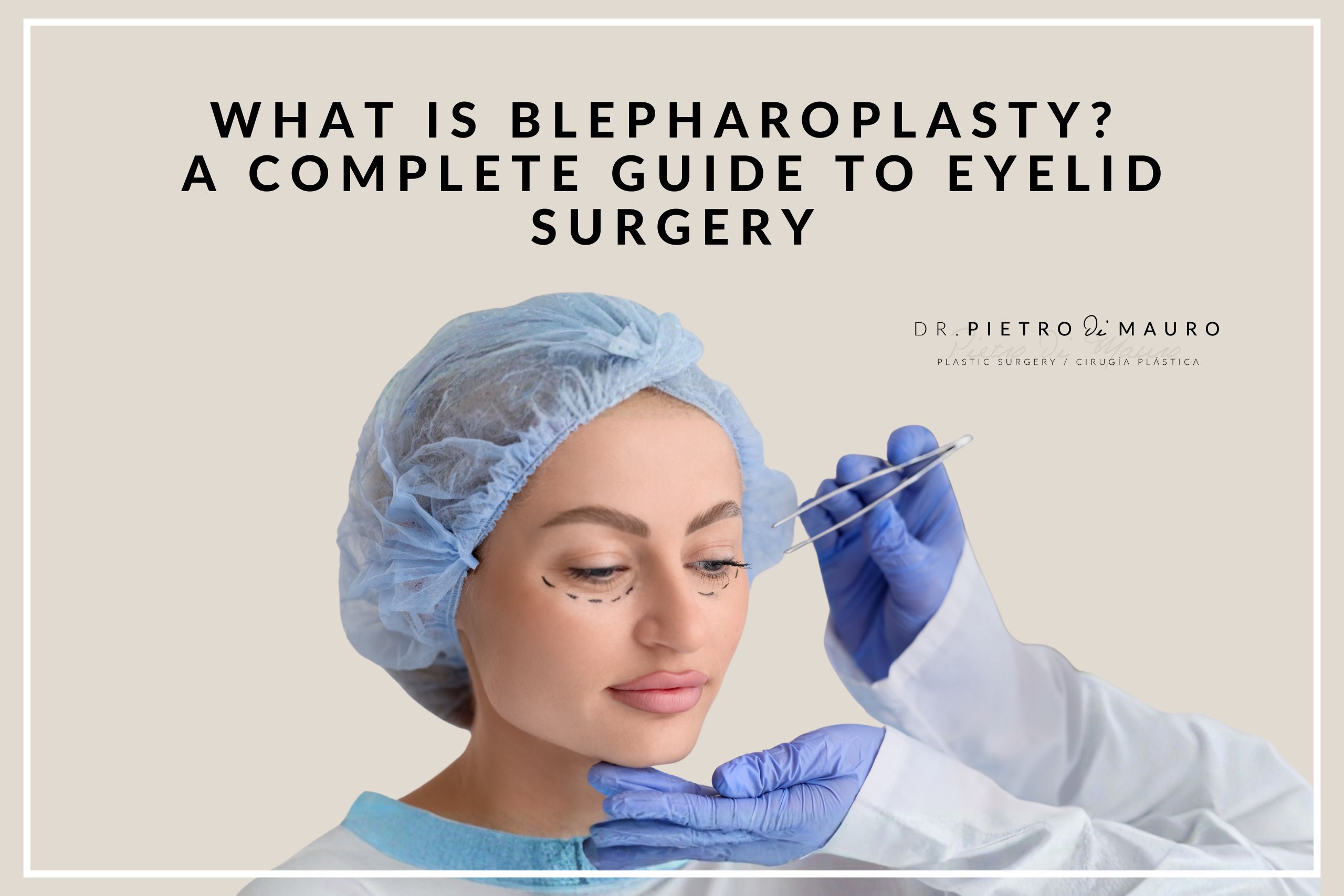
Blepharoplasty, commonly called eyelid surgery, or an eyelift,is a procedure that reshapes the upper eyelids, lower eyelids, or both. It can be done for cosmetic reasons (to reduce hooding or under-eye bags) and for functional reasons (when drooping lids interfere with vision).
If you’re researching blepharoplasty, you probably want three things:
- Definition: Gain a clear understanding of what the procedure involves.
- Are you suitable? Find out who is (and who isn’t) a good candidate.
- Outcomes: Recovery time, risks and possible results
In this guide, Dr Pietro di Mauro covers all of this in plain English, so you can make an informed decision whether blepharoplasty is the right cosmetic surgery procedure for you.
What is the definition of blepharoplasty?
Blepharoplasty is a surgical procedure that removes or repositions excess skin and fat, and sometimes a small amount of muscle, from the eyelids. It’s most commonly used to treat upper eyelid hooding, where loose skin folds over the lash line, and under-eye bags caused by fat bulges and puffiness beneath the eyes.
While it can make the eye area look lighter and more rested, the aim is usually subtle: a gentle refinement that restores a cleaner, more defined eyelid shape rather than changing how you look.
Why people get eyelifts
Patients typically consider blepharoplasty for two reasons: cosmetic improvement or to improve functionality.
Cosmetic
From a cosmetic point of view, it can help you look less tired without looking like you have had work done, reduce the heavy look of the upper lids, smooth the transition from the lower lid to the cheek, and improve facial symmetry, especially if one eyelid droops a little more than the other.
Functionality
Functionally, an upper blepharoplasty may be recommended when sagging skin starts to interfere with day-to-day comfort and peripheral vision, causing eye strain from constantly lifting the brows, or leading to irritation where skin rubs or folds. It’s also worth noting that in some cases, a droopy eyelid can be caused by ptosis, which is a muscle problem as opposed to a skin issue that may need a different type of surgery, alongside blepharoplasty.
Most commonly, blepharoplasty treats:
- Hooding over the upper eyelid (extra skin that folds over the lash line)
- Under-eye bags (fat bulges and puffiness below the eye)
- Tired or heavy-looking eyes
- In some cases, reduced peripheral vision from droopy upper lids
Types of blepharoplasty
Blepharoplasty is an umbrella term for surgery on the eyelids, covering procedures on the upper and lower eyelids, or both, and, in some cases, surgery is used to create or define an upper eyelid crease.
Upper blepharoplasty
As the name suggests, upper blepharoplasty focuses on the upper eyelid crease area and is most often done to address heaviness and sagging. The aim of the procedure is to tighten and refine the contour so the upper lid looks cleaner and lighter, while still looking natural. The procedure involves removing excess skin and the adjustment of a small amount of fat, if required.
Lower blepharoplasty
This procedure addresses under-eye puffiness and bags. The technique used will depend upon the cause of the issue of the problem. If the main issue is bulging fat rather than the quality of skin, the incision would be made inside the lower eyelid so there’s no visible external scar (transconjunctival). However, if there is a significant amount of loose skin to tighten, the incision would be below the lashes (sub ciliary).
What happens when you undergo blepharoplasty surgery?
In most cases, blepharoplasty follows a straightforward step-by-step process:
- Step 1: Consultation with Dr di Mauro
Your surgeon evaluates eyelid anatomy, brow position, skin laxity, and tear film/dry eye risk. At this stage, you will need to provide your medical history and disclose any health issues to ensure your suitability for the procedure. You will also have the opportunity to discuss the process, risks and recovery schedule and plan.
- Step 2: Planning and photos
Once you’ve decided to proceed, Dr di Mauro will mark the eyelids before the operation to ensure symmetry and precise placement of the skin and muscle.
- Step 3: Anaesthesia
The procedure is often carried out under local anaesthesia with sedation; sometimes general anaesthesia is used for combined procedures.
- Step 4: Incisions
As mentioned above, if you are undergoing an upper blepharoplasty, the incisions will be hidden in the natural crease of the eyelid. And with a lower blepharoplasty procedure, the incision will be hidden inside the lid or under the lashes, depending upon the technique.
- Step 5: Reshaping
Dr di Mauro will trim the excess skin and reposition the fat in order to create the desired more refined contour.
- Step 6: Post-operative recovery plan
After the skin and fat have been correctly repositioned, the incision will be closed using fine stitches and dressed. You will then be provided with a personal post-operative recovery plan.
Blepharoplasty recovery timeline
Blepharoplasty recovery varies depending on whether you have upper, lower or combined surgery, but a realistic timeline looks like this:
Days 1–3: During the first three days the swelling will be at its worst and bruising will start to appear, at this time it is important to rest in order to promote healing and cold compresses can be used.
Days 4–10: Visible bruising usually starts to improve, any non-dissolving stitches may be removed during this window, and many patients feel ready to return to work (depending upon the type of work).
Weeks 2–4: Most of the bruising will be gone, though mild swelling may remain.
Months 1–3: Results continue to refine as scars soften and gradually fade, revealing a more rejuvenated, natural-looking eye area.
Blepharoplasty risks
Dr di Mauro provides all potential patients with essential information about blepharoplasty, your suitability, possible results and potential risks.
He explains that blepharoplasty is generally safe when performed by an experienced, board-certified plastic surgeon, but like any surgical procedure, it does carry potential risks. These can include bleeding or infection, temporary dry eyes or irritation, and swelling that lasts longer than expected. In some cases, patients may experience asymmetry or under/over-correction, and lower eyelid surgery can occasionally lead to the lower lid pulling downward (ectropion). Rarely, more serious vision-related complications can occur.
- Bleeding or infection
- Temporary dry eyes or irritation
- Swelling that lasts longer than expected
- Asymmetry or under/over-correction
- Lower lid pulling down (ectropion) in some cases
- Rare vision complications
The best way to minimise risk is by choosing a surgeon who has extensive experience and is a specialist in blepharoplasty, not a surgeon who treats it as an additional service.
How to choose the right blepharoplasty surgeon
Choosing the right blepharoplasty surgeon is one of the most important factors in getting a safe procedure and natural-looking results. Before you decide anything, you should create a checklist that will help you ascertain the experience, qualifications and track record of your potential surgeon.
You should choose a plastic surgeon who fulfils all of these points:
- Specialist in eye-focused plastic surgery
- Before/after images of procedures carried out on patients in your age range and with your eyelid type
- Talks about brow position, dry eye risk, lid support: not just skin removal
- Explains techniques and possible results clearly and honestly
- Has a personable bedside manner, professional team and modern clinic
- Qualifications, experience and membership of the Spanish Society for Plastic Surgery and Aesthetic Surgery (SECPRE)
Final takeaways
Blepharoplasty can be one of the most effective ways to refresh the eyelid area because it improves the underlying structure, skin, fat and overall contour, not just the surface. If you’re considering it, the best results usually come from the same essentials: the right diagnosis, the right technique, the right surgeon, and realistic expectations for recovery. Take your time, ask thoughtful questions, and choose the approach that supports a natural, well-rested look.
Considering blepharoplasty and want to discuss your options with Dr Pietro di Mauro? Request a personalised consultation to explore the most suitable approach based on your goals, anatomy, and lifestyle. This tailored approach helps ensure a natural, well-rested result that enhances, rather than changes, your features. Call +34 648 434 593 or email info@pietrodimauro.es.
FAQs
Blepharoplasty results can last for many years, but they aren’t truly permanent because the natural aging process continues. Most patients find that their eyes look consistently more open and well-rested long term, and the under-eye contour often stays improved, especially when fat is repositioned rather than removed. Over time, if anything is needed, it’s usually smaller maintenance options like skin tightening or resurfacing rather than having to repeat the surgery.
After an eyelift, most people can wear makeup again at about 10–14 days, once the incisions are closed and any stitches (if applicable) have been removed. Start gently with clean products, avoid rubbing or tugging the lids, and hold off on waterline eyeliner until your surgeon gives you the go-ahead, this is especially important, if you are prone to dry eyes.
A successful result should look like you, just more rested, not like a new face. Early on, swelling and bruising can temporarily change your eye area, but as healing settles, the outcome should look natural. If you’re concerned, ask to see before/after photos of patients with similar eyelids and tell your surgeon you want a subtle, not overdone, result.